Background
400 Westlake is a landmark development located in the heart of Seattle’s South Lake Union neighborhood. Completed in 2023, this 15-story commercial building transformed the historic 1929 Firestone Tire Building into a next-generation center for sustainability and innovation. The Project participates in Seattle’s Living Building Pilot Program, which supports developments that generate net-positive energy, capture and treat all water on-site, and use only non-toxic building materials.
The building generates 105% of its own energy needs and has received notable accolades, including the 2023 Energy Vision Award from the Seattle 2030 District and the 2024 CoStar Impact Award for Commercial Development of the Year. A major contributor to these achievements is its integrated rainwater and graywater reuse system by Rainwater Management Solutions (RMS), which supplies all the building’s non-potable water closet needs.
The design blends high-performance environmental systems with Seattle’s rich architectural heritage, preserving the original facade while incorporating comprehensive sustainable practices and advanced resource reuse strategies.
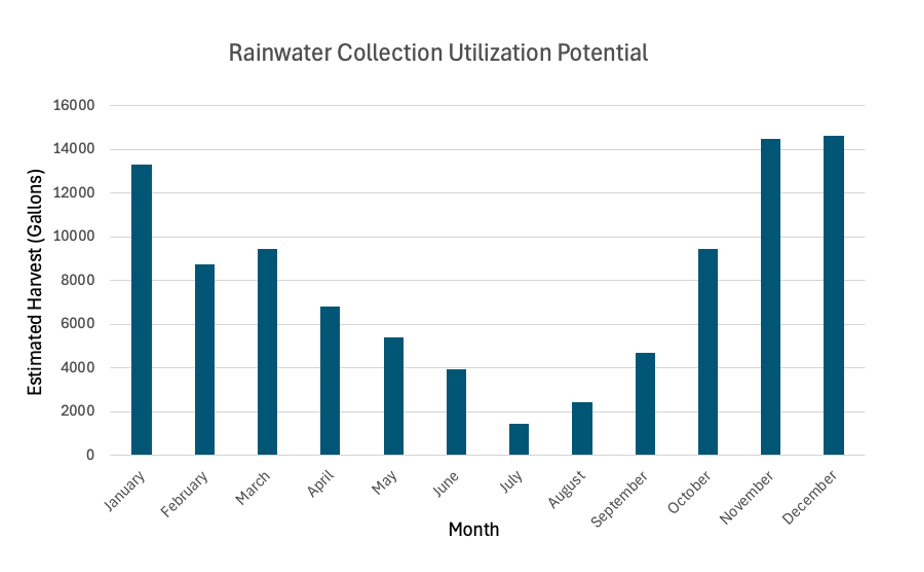
Figure 2. Estimated monthly rainwater harvest (in gallons) based on 400 Westlake’s 19,440 sq ft rooftop, local precipitation data, runoff coefficients, system overflow, and dry-day losses.
System Design
400 Westlake uses a dual-source reuse system that integrates both rainwater and graywater to supply non-potable water, primarily for toilet and urinal flushing. Rainwater is harvested from the 19,440-square-foot rooftop, allowing for an estimated annual collection of 263,967 gallons (see Figure 2). Collected rainwater passes through a WISY WFF 300 vortex filter, which removes particulates larger than 350 microns and retains up to 95% of collected water. Prefiltered water is then stored in a 107,000-gallon cistern which is large enough to meet 96% of the building’s non-potable demand from rainwater alone. An RMS treatment skid filters down the water to 5 microns using bag filters and purifies with UV disinfection to meet regulatory standards with consistent monitoring and performance assessments.
Graywater — sourced from sinks, showers, drinking fountains, and similar fixtures — follows a similar filtration path. It first passes through WISY prefiltration and is then treated by the GW 2500 Grayworks treatment skid. This RMS developed system includes a multi-barrier process: biofiltration, media filtration, UV disinfection, an RMS 200 controller, chemical injection, and monitoring software. The system treats up to 2,500 gallons of graywater daily, which has the potential to exceed the building’s calculated daily average non-potable flushing demand of 1,056 gallons by over 237%.
A VFD-controlled booster pump draws water from the Grayworks treatment tank, pushing it through the system. A downstream hydropneumatics tank stabilizes pressure and prevents short cycling. To improve treatment of graywater, a coagulation injection system is used to remove fine particles. The water then passes through a zeolite media filter (for ammonia and sediment), an activated carbon filter (for detergents, chlorine, VOCs, and odors), a 5-micron sediment filter, and an ultraviolet disinfection unit capable of providing a dosage of 186 mJ/cm2. Flow meters monitor water throughout every stage of the filtration process to ensure quality and uphold health requirements.
Both systems include turbidity monitoring, automated drain lines, and motorized valves to ensure operational safety and regulatory compliance. Treated rainwater and graywater are combined in a 1,000-gallon day tank, which is designed to handle peak flow demands for the building. When insufficient rainwater or graywater is available, a backup domestic water supply is automatically utilized to prevent dry running and maintain system continuity. A chlorine-injected recirculation pump operates at scheduled intervals to prevent stagnation and ensure water quality. The system continuously monitors pH and free chlorine levels to maintain disinfection efficacy and meet local plumbing codes. It is equipped with sample ports, pressure transmitters, alarms, and system isolation features to support ongoing maintenance and system integrity. This dual-source structure ensures a constant and reliable supply of non-potable water by leveraging the consistent availability of graywater (approximately 1,060 gallons per day) alongside the variable input of rainwater (around 700 gallons per day) to sustain a resilient and efficient system for toilet and urinal flushing (see Figure 3).
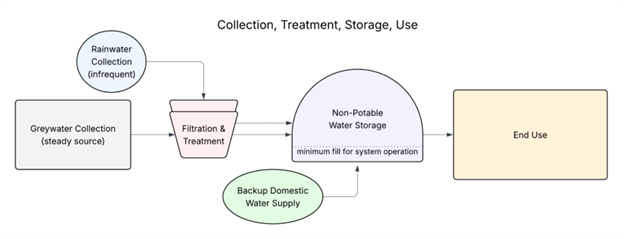
Figure 3. Graywater and stormwater collection system diagram detailing the building’s water conservation capabilities using a primarily dual-sourced structure.
Challenges
As one of the first sizeable environmentally conscious commercial buildings of its kind, 400 Westlake’s integrated rainwater-graywater system presented a new scale of technology. With limited local precedent, the project was examined closely by regulators seeking to ensure public health and safety requirements. This led to greater engagement between the project developers, system designers, and state officials, prompting the Washington State Department of Health to begin developing WAC 246-275— a series of comprehensive regulations for onsite non-potable water systems (ONWS). These rules propose requirements around treatment standards, fees, monitoring, permitting, and enforcement using a risk-based log reduction approach.
Risk-based log reduction frameworks use Quantitative Microbial Risk Assessment (QMRA) to establish Log Reduction Targets (LRTs) that ensure water safety based on its source and use. Although still in draft form, these guidelines require rigorous treatment levels.
Current discussions propose turbidity levels below 0.5 NTU for non-potable uses of both graywater and rainwater, which are more stringent than the 1 NTU standard for potable water requirements in the same regulatory system. If adopted, these regulations would require ONWS water to meet standards stricter than tap water. Though not yet law, 400 Westlake meets or exceeds these proposed requirements, achieving 99.99% virus and bacteria reduction (4-log) through its multilayered RMS filtration and disinfection process.
Outcome
The 400 Westlake project has played a critical role in influencing both local and state regulatory frameworks for onsite non-potable water systems (ONWS). As a direct result of this pioneering development, the Washington State Department of Health began drafting WAC 246-275 to formalize performance, permitting, and monitoring requirements for rainwater and graywater reuse systems. The building exemplifies the guiding principles set forth by the National Blue-Ribbon Commission (NBRC), including a commitment to protecting public health, developing science-based policies, utilizing a consensus-based approach, integrating best practices, honoring local context, and committing to continuous learning throughout its construction and lifespan.
Functionally, 400 Westlake has demonstrated the effectiveness and viability of dual-source water reuse systems. By integrating rainwater and graywater treatment to support non-potable water demands, the building achieved significant reductions in potable water use. Its energy performance exceeds expectations, with the design using 75% less energy than the baseline established by the 2012 Seattle Energy Code. This reduction in water and energy use also translates into substantial long-term operational cost savings due to decreased reliance on municipal utilities. Furthermore, the building has been widely recognized for its leadership in sustainable design, receiving multiple awards, and pursuing certification through the Living Building Challenge. Through this project, 400 Westlake has not only advanced sustainable water practices but also set a precedent for future high-performance buildings in Washington and beyond.